|
VVN Blog: October 7, 2026
A Month for the Macabre
 If you have a taste for the macabre, the Victorian world will give you all that you might desire in the way of things ghoulish and creepy. This month, I invite you to indulge that taste with some excellent books addressing the Victorian way of life – as expressed in the Victorian way of death! But don't skip over this post if you don't much care for the macabre, because these books aren't just for those with a ghoulish frame of mind. They offer a remarkable window into an aspect of Victorian life that is still not well understood today, and they're fascinating reading for just about anyone.
The first is The Victorian Book of the Dead, by Chris Woodyard (2014). This book truly offers "everything you ever wanted to know about how Victorians dealt with death," and possibly a few things you might not have wanted to know. Here you'll find plenty of sensational – yes, macabre – details, such as exploding corpses, peculiar jobs (such as serving as a barber to the dead), and some excellent reasons why Victorians had such a horror of being buried alive. But you'll also find a wealth of detail on nearly every aspect of the Victorian approach to death, including funerals, mourning, the controversies surrounding mourning costume (that deadly crape veil, for example), and a look at how customs evolved over time.
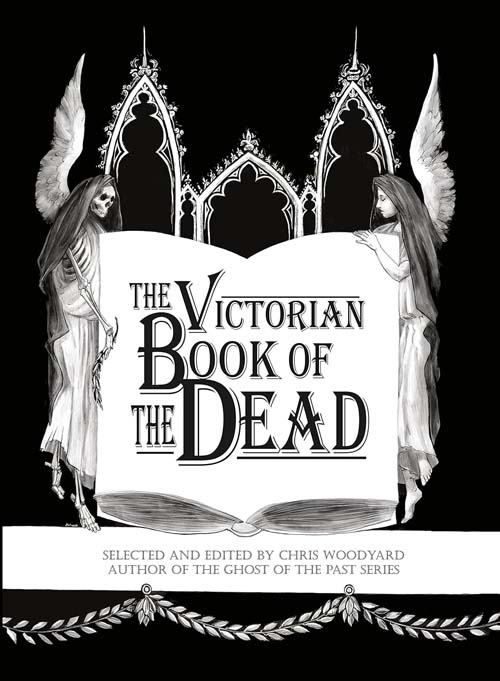
The Victorian Book of the Dead
|
Woodyard doesn't claim to be the "author" of this book, but rather, its editor – and here she is an author after my own heart, for the book consists primarily of original source material drawn from contemporary newspapers, magazines, and books. Most of the material comes from the US, but there are many examples from Britain and Europe. Where the book shines is the selection of snippets that create a coherent narrative. Woodyard's commentary introduces the materials, offers explanation and backstory where needed, and also lets the reader know when an article might not be completely factual. She does not judge, editorialize, or sensationalize, but allows the material to speak for itself – and for us to draw our own conclusions. This makes for a much more pleasant reading experience of what can be, at times, an unpleasant subject.
The book covers a wide range of topics, including premonitions (or "tokens") of death, ghostly visitations, strange funeral trades, mourning etiquette and products, post-mortem photography, and the ever-evolving world of mourning novelties. One take-away is the sad fact that, especially in America, death was big business. The funeral trade constantly sought more ways to make money from death, including novelties like black cigarettes for mourners, mourning bicycles that could safely be used by widows in full mourning, elastic shoes for the dead, and more. It was an era of elaborate, over-the-top, and often stunningly tasteless funeral displays with multiple carriages, "weepers," carved mahogany coffins, glass coffins, ostentatious mausoleums, and sentimental monuments.
These details also make it clear that many of the practices (and excesses) that we'd consider macabre today were considered macabre at the time as well. We're often told that, because Victorians were so much more familiar with death than we are, customs we'd consider "creepy" were wholesome by their standards – but this often isn't the case. The very fact that such customs and events were written up in newspapers for their sensation value is a clear indication that they weren't regarded as "normal."
For example, you'll find many blogs arguing that post-mortem photography was a loving, natural way to preserve an image of a departed loved one. We're also told that these photos were taken because photography was "too expensive" for the average person, and this was perhaps the only opportunity to capture a portrait of a loved one. That, however, doesn't account for the custom persisting into the early 20th century – or the fact that such photos were often commissioned (with multiple copies) by well-to-do households. Nor did Victorians generally regard this as a sweet, loving custom; even the photographers, though willing to earn that extra dollar, regarded it as distasteful.
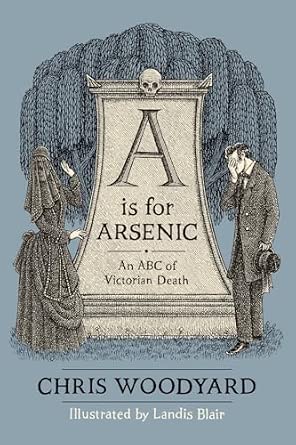
A Is for Arsenic
|
On the whole, this book is hard to put down – it's informative and entertaining. On the flip side, it's long – 361 pages – so it can be a bit daunting to wade through. If you're interested in a shorter tour of Victorian death, consider Woodyard's A Is for Arsenic: An ABC of Victorian Death (2023), which weighs in at 184 pages (not counting the index). As Woodyard notes in the introduction, it "is designed as an accessible, accurate, and at times, entertaining, introduction to the basics of Victorian mourning and death... With so much historical disinformation circulating, it seems a useful goal to make the customs of the past... come alive."
As the title suggests, it begins with a discussion of arsenic, the method of choice for poisoners, and the reason pharmacies at last began to limit access to poisons. (You could still get them, but you had to sign the "poison book," and be known to the pharmacist, or to someone the pharmacist trusted.) Some other topics include embalming, jet jewelry, "keening," the necropolis cemetery, resurrection-men (body-snatchers), and zinc (used to make tombstones). It also offers a chronology of mourning fashion etiquette, and a useful glossary.
While these two books look at what happens after death, how about how someone gets there in the first place? In Victorian Britain, the route was often through murder most foul – and if true crime is your cup of tea, you won't want to miss Simon Potter's trilogy, Lincolnshire's Victorian-Era Murders.
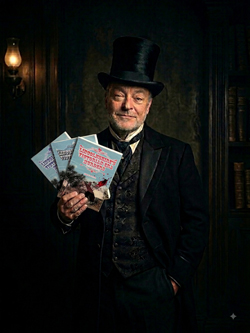
Simon Potter
|
This collection documents over 100 murders in all, ranging from the beginning of the Victorian era to its end. Most accounts are drawn from the Lincolnshire press – because, as the author notes, as early as 1850, The Lincolnshire Free Press declared that "If every paper does not contain a goodly number of horrible murders, it is a dull unwelcome sheet." And, Potter notes, a great many murders that might have been reported as "horrible" in the press were often rather mundane in reality. It's a nice reminder, however, that tabloid journalism is not a modern invention!
What stands out as one reads this collection of chilling accounts is how little excuse was required to commit murder in the 19th century. All one had to do, to ensure one's almost certain demise, was to flash a few coins around at the local pub. Domestic disputes often escalated, in an instant, to deadly violence. Less commonly, they were resolved by a slow and calculated process of poisoning, with arsenic again tending to be the weapon of choice.
While the accounts are fascinating, so, remarkably, are the footnotes. I don't generally pay a great deal of attention to footnotes, but Potter uses these to help clarify background information and details, such as what a person's designated profession actually involved, or the types of items mentioned in the account that might no longer be familiar today. Also, with what must have involved a monumental amount of research, the footnotes identify the locations of the crimes as they were and as they are today. Thus this book offers not only a walk through crime but a walk through time.
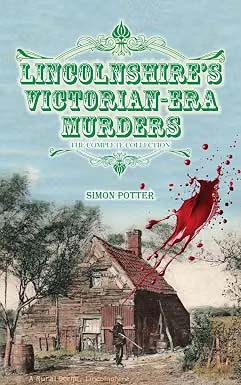
Lincolnshire's
Victorian-Era
Murders
|
This collection comes in three print volumes (red, white, and blue), each of which stands alone and offers the same introductory material (which is also a fascinating overview of how murders were handled, reported, and punished). The complete collection is available as a single volume on Kindle. (That one is green.)
Well, that's enough of the macabre for this post, but the month isn't over. On October 21, Simon Potter's guest blog offers a look at the Victorian public's obsession with crime, from newspapers to penny dreadfuls to public executions. On November 7, Chris Woodyard brings us a guest blog on (TBD). Hmm... perhaps for Thanksgiving I should follow these up with a blog giving thanks that we don't live in the 19th century!
Find Out More:
Chris Woodyard
https://thevictorianbookofthedead.wordpress.com/
http://hauntedohiobooks.com/
The Victorian Book of the Dead
A Is for Arsenic: An ABC of Victorian Death
Simon Potter
https://www.victorianmurders.co.uk
Lincolnshire's Victorian-Era Murders
Find out more about:
Mourning & Funerals
Victorian Crime and Law Enforcement Techniques
Victorian Criminal Cases
|
|
|
 Discover thousands of Victorian images in our