 If Victorians can't truly be characterized by broad-brush statements about "attitudes" and "mindsets" that lump all Victorians together without respect to demographics or dates, then... why do so many writers and scholars get the idea that such attitudes were representative of the era? The answer is simple: From the Victorians themselves.
You'll find no end of examples of those "classic" Victorian attitudes (especially regarding gender roles) in Victorian magazines, books, newspapers, sermons, and many other sources. You'll find them in editorials, letters to the editor, advice features, and lengthy feature articles. You'll find them in fiction and poetry. And if that's the case, how can I say such attitudes don't represent the "Victorian mindset"?
Let's start by reviewing the things that changed during the 19th century. We know that in that period, women achieved remarkable progress in a wide range of rights. In the 60 years between the 1840s and the end of the century, women gained access to higher education, a process that involved the founding of numerous colleges and degree programs for women. Women also gained access to an ever-increasing array of jobs and careers. Married women, after considerable struggle, gained the right to retain their property. Women became involved in nearly every area of sports, and even began to play professionally. Though custody rights to children were still a complicated area, women made significant strides there as well. Women wouldn't gain the right to vote until the 20th century, but the suffrage movement was born in 1848 and, by the end of the century, had a vast following amongst both sexes, on both sides of the Atlantic. Besides the strides in women's rights, the Victorians were the first to create a great many laws to protect children, including laws that prevented the use of children as chimney sweeps, took children (and women) out of the coal-mines, and restricted the hours (and ages) that children could be required to work.
In short, a lot of change happened – and where change happens, there is opposition. We need only look at our own time to see the same. No matter what the change or what "party" proposes it, the media (whether legacy or social) will instantly be flooded with articles, editorials, letters, and so forth, decrying it. Victorians were the same; like us, they were divided and conflicted, embroiled in a host of controversies, with strong opinions and emotions on both sides.
Thus, you will find articles, stories, letters, editorials, and so forth, expressing opinions held by some or even many Victorians who strongly opposed the changes that were occurring around them. These are not, however, the opinions or mindsets of the majority of the population. They are, instead, a reaction to what is occurring amongst the majority of the population.
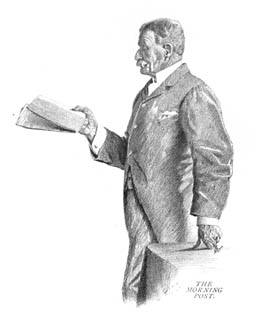
"The Morning Post" |
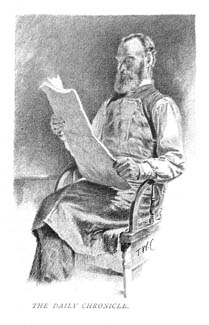
"The Daily Chronicle" |
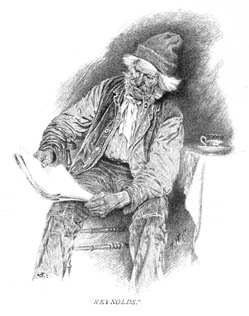
"Reynolds" |
Just as today, the diversity of opinions in Victorian society was reflected in the newspapers individuals chose to read. This set of images and those that follow show the Victorian view of different "types" and their preferred news sources!
English Illustrated Magazine, 1893
|
For instance, in my blog on The Perils of Reading, you'll find examples of the outcry against the craze for reading fiction. Many Victorians were convinced that (in modern terms) fiction would rot your brain. It would destroy your morals, overstimulate your fragile female brain, and leave you unfit for "healthy" reading. Yet despite such virulent editorials, we know that most Victorians enthusiastically embraced fiction; who today has not heard of Sherlock Holmes or Ebenezer Scrooge? And to remind us that Victorians weren't alone in this sort of reactionary thinking, many of us can probably remember receiving similar warnings about radio, movies, television, video games, comic books... all the way to today's concerns over AI.
The issue of higher education for women provided fuel for Victorian "anti-tudes" for decades. Despite the steady proliferation of women's colleges, degree programs, and certifications, a great many Victorians still held the vain hope that, somehow, a well-placed editorial, or perhaps a story with a very obvious moral, might turn back the clock, or at least dissuade a few women from following such a selfish path. In 1882, for example, The Girl's Own Paper ran an opinion piece titled "The Disadvantages of Higher Education," by "M.P.S." This author warns,
Do we not all know dozens, if not hundreds, of cases, even among our own friends, where "the unbelieving husband is sanctified by the wife"? Where the man who has been careless and irreligious is gradually brought into the right way by his wife? Where a mother's quiet wisdom keeps her sons straight, among the innumerable temptations which beset them, at school, at college, and on their going into life?... No doubt a certain amount of knowledge is necessary to fit us for this life; but, married or unmarried, a woman (if only she knows what she knows, and is taught when a child to do her work thoroughly) can find plenty of work lying ready to her hand, and she will be far more useful doing than studying.
This gives us a rather dim view of the typical Victorian male, who, if MPS is to be believed, would be little more than a degenerate, grunting brute if not for the influence of the female. One also wonders what sort of company a person would be keeping to know "hundreds" of such cases amongst their own friends! But leaving that aside, a few issues later, GOP ran a delightful rebuttal by 14-year-old Bertha Jenkinson, who offers a more realistic anecdote to support her view:
There is an anecdote I have read which I think is appropriate to the subject in hand... 'When I lived among the Choctaw Indians I held a consultation with one of their chiefs respecting the successive stages of their progress in the arts of civilized life... he informed me that at their start they made a great mistake—they only sent boys to school. These boys came home intelligent men, but they married uneducated... wives, and the uniform result was the children were all like their mothers... "And now," said he, "if we would educate but one class of our children, we would choose the girls, for when they become mothers they educate their sons."'*
Bertha makes one false assumption: She's convinced that M.P.S. must be a man. In a footnote, -GOP tells us that M.P.S. is in fact a woman. (M.P.S. herself gave us one small clue in her statement, "to fit us for this life.") Today, if we didn't know better, we'd probably assume, like Bertha, that M.P.S. was a man displaying a "classic" repressive view of women's education. The fact that M.P.S. was a woman is a reminder that anti-feminist attitudes were held by a great many Victorian women as well as men.
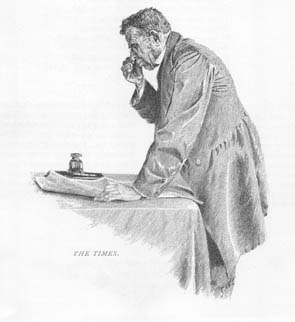
"The Times" |
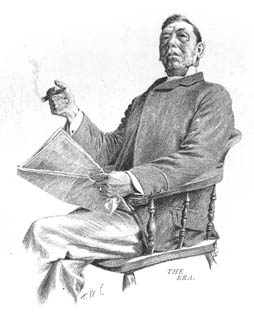
"The Era" |
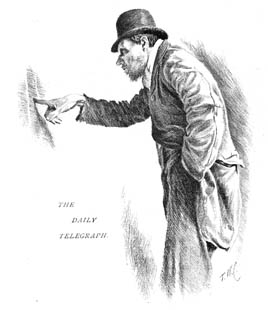
"The Daily Telegraph" |
In 1889, The Girl's Own Paper ran a story titled "A Society for the Prevention of Cruelty to Mothers." Marion's mother asks for a little help, but Marion is too busy: "I have this essay to finish for the society this evening. I must go to our French history class in an hour, then to a guild meeting, and get back to my German lesson at five o'clock..." However, as she "wearily [gives] a finishing touch to 'The Development of Religious Ideas Among the Greeks," Marion fancies she sees the angels of life and death hovering over her exhausted mother. The angel of life explains,
Those grey hairs come from overwork, and anxiety to save extra money for the music and French lessons. Those pale cheeks faded while the girls were painting roses and pansies on velvet or satin... Young ladies must be accomplished now... Those eyes grew dim sewing for the girls, to give them time to study ancient history and modern languages... That sigh comes because their mother feels neglected and lonely, while the girls are working for the women of India; that tired look comes from getting up so early, while the poor exhausted girls are trying to sleep back the late hours they gave to study or spent at the concert...
Needless to say, Marion realizes the error of her ways, and devotes herself to the care of her poor mother. A few months later, a woman in her woman-rights class remarks, "You seem to have lost all your ambition to be highly educated. You are letting your sisters get ahead of you..." But the woman also adds, "I have never seen [your mother] looking so well," and Marion feels amply rewarded for being the founding member of the "SPCM."
One wonders why, as late as 1889, the author even bothered; this little cautionary tale is a good example of trying to shut the barn door after the horse has reached the next county. It's worth noting, however, that The Girl's Own Paper was not opposed to women's education; it had already been publishing articles on "our" women's colleges, how to study for exams and certificates, and so forth, for nearly a decade. (One wonders if it published bits like those above simply to stir their "girls" into action!)
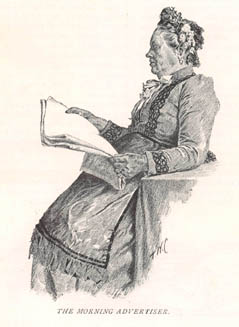
"The Morning Advertiser" |
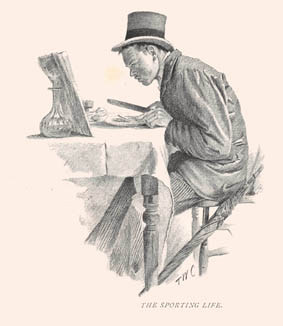
"The Sporting Life" |
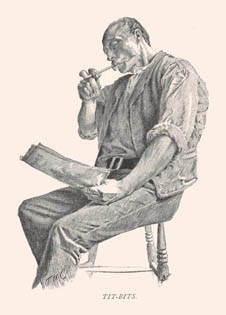
"Tit-Bits" |
The attitudes of the opposition are not hard to find. Those who opposed change in the Victorian world were outspoken, and if one simply takes what one reads at face value, it's easy to suppose that these attitudes reflect the mindset of the Victorian world. To understand that mindset more accurately, however, one needs to look at the attitudes that prevailed – and brought about the myriad of changes that, today, we take for granted.
At the same time, we should be a bit less hasty in condemning the "backwards" attitudes of the "opposition." The Victorian world was one of rapidly evolving changes, and in any such world – including our own – many people start to feel as if they, and their values, are being left behind. Today, many of us may find ourselves in the same situation, and it will be up to history to decide which attitudes "prevailed" and which were to be condemned. In the meantime, if someone tells me that I have a "Victorian" attitude, I will simply smile and thank them politely for the compliment.**
*Though I have not been able to track down the original author of this anecdote, it appears in American newspapers as early as 1857. It was reprinted in 1910 in J. Purver Richardson's Life and Literature (available from Project Gutenberg), and quite probably appeared in some similar British compilation of an earlier date.
**And, of course, refer them to this blog!
For More Information:
- Women's Education: Should She or Shouldn't She?
- https://www.victorianvoices.net/topics/education/women.shtml
- Here you'll find lots of wonderful arguments from both sides of the question of higher education for women.
- The Disadvantages of Higher Education
(Girl's Own Paper, 1882)
- "Woman was created as an helpmeet for man, not as his equal or rival; and woman nowadays is very apt to forget that fact," writes the author of this article. But don't miss the rebuttal from a 14-year-old girl on the next page!
- A Society for the Prevention of Cruelty to Mothers
(Girl's Own Paper, 1890)
- As the GOP publishing year ran from October through September, this article was actually published in October 1889, but is included in the 1890 Annual.
Read the Complete "Victorian Attitudes" Series:
- Victorians with "Attitudes"
- Not-So-Victorian Attitudes
- Victorian "Antitudes"
|
|
 Discover thousands of Victorian images in our