 In the previous etiquette column, I gave you some of my views on the "point" of etiquette. However, it wasn't simply the post-Victorian world that questioned whether etiquette was important or useful. Victorians – who had to live with it – often questioned it as well. Here's what two Victorian sources have to say about the general purpose of etiquette.
An excerpt from "The Etiquette of Society,"
Cassell's Book of the Household, 1890
Different people attach different degrees of importance to the rules and laws of etiquette. Some regard them as worthy of diligent attention and endless study, and others look upon them as unworthy of the slightest consideration, and even take a pride in openly disregarding them. If there is any truth in the old saying that "manners make the man," it is surely unwise to act in opposition to the recognised rules which, to some extent, govern the actions of well-manned people in society. It may not be necessary, or advisable, to learn by heart these rules; such a course would probably only lead to stiffness of manner and awkwardness of motion, which could only cause discomfort to others; but it is equally ill-advised to disregard them.
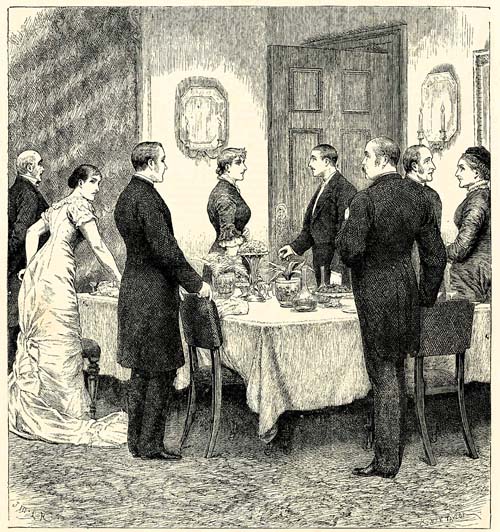
A Victorian Dinner Party
The Girl's Own Paper, 1880
Etiquette, and the various rules in connection with it, have their origin in true politeness; and true politeness is only one of the results of unselfishness, consideration for others, and courtesy. No amount of study of the laws of etiquette can make a selfish person really polite – polite not only in society, but in every-day life; whilst some people, who are ignorant of every law and rule, are so thoughtful for others, that they are considered to be extremely polite by their friends and acquaintances. A certain knowledge and practice of these conventional laws not only tend to make intercourse with other people more agreeable and pleasant, but are very great social safeguards against undesirable acquaintances.
Etiquette has been much laughed at, and its rules have been held up to popular scorn and derision by many people, but that is because these people have wrong ideas, and look only at the letter instead of the spirit of the law. Independent people are apt to think, that in obeying the laws of etiquette they are giving up their freedom and independence of action. They forget that it is impossible to act without affecting, in some greater or less degree, other people's actions or wishes; and that complete freedom for one may mean a lack of consideration for others. On the other hand, if any law of etiquette becomes hurtful to others, a truly polite person will break it rather than offend another. The small details which so often crop up in every-day life, must be settled by individual taste and feeling.
Etiquette and good manners are not exactly the same thing. Etiquette is a general term which chiefly means certain customs, and ways of doing things, recognised by society. Good manners belong more to the individual, and include not only good feeling, but such composure and absence of self-consciousness that, if placed in a new and strange situation, he or she would unconsciously obey the law of etiquette and do the right thing; or, if the wrong thing was done, it would be with such grace and charm that no one would notice it as wrong. It is possible to be perfectly well-mannered, and yet be ignorant of some of the minor points of etiquette.
An excerpt from "The Foundation of All Good Breeding"
by Sophia F.A. Caulfeild, The Girl's Own Paper, 1880:
Manuals pretending to supply all the recognized rules of etiquette may be obtained for a few pence; and articles quite as numerous have been presented to all who feel themselves deficient in their knowledge of sundry little trifling matters, to which, persons from under different circumstances are familiar from their childhood...
First, I wish to bring before your notice that we must be governed by certain general rules in every position and circumstance of life. Secondly, to distinguish those that are obligatory on all ranks of society, and those that belong only to a single class. Thirdly, that, to ensure the full exercise of all our theories on the subject of good manners, we must cultivate tact. Fourthly, that no books of etiquette need to be studied by the community at large when the foundation of all good breeding is thoroughly understood...
Throughout the whole of Creation certain rules must govern every separate department of the vast extent of God's universe. The better versed you are with science, and with nature, the more clear this will become to your apprehension... And in a less perfect and regular way human affairs must be carried on by the observance of certain rules of more or less significance... We cannot repudiate the obligation of being guided and governed by rules, from the highest circles of the aristocracy to the unpolished ranks of uneducated multitudes... Without these rules the world would be what is characteristically called a "bear-garden."
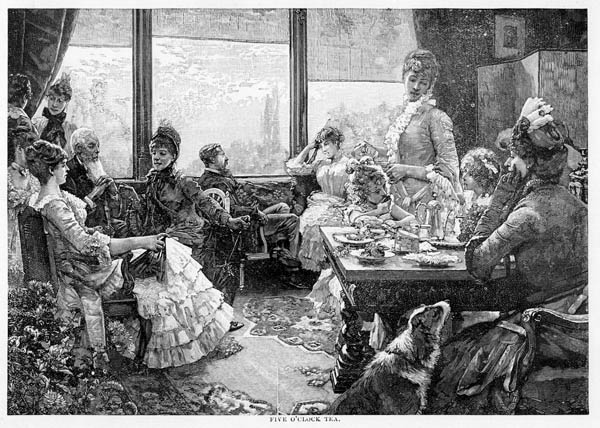
Five-O'Clock Tea
Logan's Home Manual, 1899
It now remains to us, in the second place. To consider the nature of those rules known by the name of "etiquette," which govern "polite society," and to decide which of them apply to educated people in general, leaving those that are non-essential, save to a distinct class (who are already as well acquainted with them all as I could be...) Because I must tell you, at the outset, that many little requirements of the higher ranks of society do not apply to the middle class, however well educated and however refined in feeling and pleasing in manner. Some of these little rules on which certain writers appear to lay so much stress, merely, it would seem, to make it appear that they themselves belonged to a class with whose habits they profess to be so conversant – some of these rules consist of little more... than a species of masonic signs, as it were, by which strangers may respectively recognise their brotherhood, each to each, in the same circle of fashionable society, sharing the same hereditary feelings, ideas, and interests.
Upon such trifling rules of so-called "good breeding" as these I am not about to descant. I wish to draw a line of demarcation between them, as belonging only to a particular class, and those which should be regarded by all ranks of society, simply, yet obviously, because founded on the great Law of Kindness, and a keen sense of fitness and propriety.
No books need to be read by those who have this key to the mysteries of "good breeding." They have only to use their own common sense, and ask themselves, in every little act which has to be performed, How shall I best spare the feelings of those around me? How shall I be able to gratify them, even though at my own expense of time or trouble? Remember that one golden rule of your life should be to regard nothing as a trifle; and still further, to do nothing that is not worth your best efforts to perform well...
From what I have already said you will draw this single conclusion, that the foundation of all good breeding is kindness, and to carry out its instincts into the actions and the converse of our daily life we must cultivate tact, using our brains and powers of reasoning and reflection for the comfort of others, at whatever self-abnegation and presence of mind, by which alone our good intentions can be made of any service...
Books of etiquette from the Victorian era often seem to be good today only for a laugh. If, however, as the Victorians themselves tell us, the foundational principles of etiquette are not about rigid rules, the shade of paper on which your calling card is printed, or which fork to use at the dinner table, then perhaps the laugh is on us. For by losing track of the foundations of what the Victorians chose to refer to as "good breeding," we have lost track of those principles of tact, courtesy and kindness that smooth interactions and enable communication, rather than stirring outrage and division. Today, I believe, we have lost track of the notion that kindness and courtesy are virtues that originate within each of us and permeate all our interactions, rather than being rare gifts we bestow only on those we deem worthy to receive them. What might the world be like if "etiquette" were, once again, a valued part of social interaction?
Find Out More:
- VictorianVoices.net Blog: What's the Point of Etiquette?
- The Etiquette of Society
(Cassell's Book of the Household, 1890)
- The Foundation of All Good Breeding, by S.F.A. Caulfeild
(Girl's Own Paper, 1881)
- For more information, visit Victorian Etiquette and Social Occasions.
|
|
 Discover thousands of Victorian images in our