 One of the more off-putting aspects of Victorian society is its emphasis on etiquette. Books and articles abound on the topic. One gets the impression that "rules" of etiquette govern just about every aspect of behavior, from which fork to use at a dinner party, to whom you may (or may not) speak to on the street, to how to behave if your chair collapses beneath you during a social call. (I'm not making that up; I actually found that example in an American book on etiquette, and apparently the poor gentleman did all the wrong things, by apologizing and trying to pay for the chair!)
Thank goodness we don't have to put up with such petty rules today! Right? OK, now, let me ask you a question. How many of you, dear readers, feel supremely comfortable and confident in every social situation? Do you always feel as if you just what to say, just what to wear, just what to do? Or do you worry that people are watching you, perhaps a bit critical in their judgment of your behavior? Do you wonder if, perhaps, you were absent on the day that everyone else was taught how to function in social situations? Do you wonder if you're truly "fitting in"?
If you're in the supremely confident category, I congratulate you. If not – if, in fact, you're one of those who would almost rather have a root canal than attend a formal office party – then, well... Now you have an answer to the question, "what is the point of etiquette?"
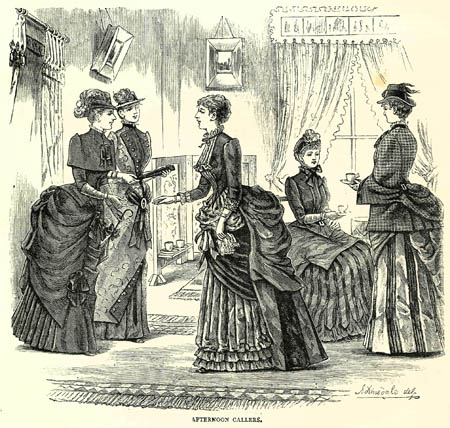
A Victorian "At-Home" Gathering.
The Girl's Own Paper, 1884
Victorian society was a very social society. People gathered regularly for a host of orchestrated social events, including dinners, teas, dances, balls, musical parties, at-homes, and more. Though some of these gatherings might be of close friends, where you could feel comfortable "just being yourself," most would be more formal. Such gatherings cemented Victorian social circles and relationships and business connections – but most importantly, they established your place in society.
Today, we don't feel that we need to worry about our "place" in society. Today, we can stay home and pretend we're "socializing" by staring at our cell phones. It's no longer necessary to connect person-to-person or face-to-face, as it was in a world with no phones, no Internet, and no social media. Consequently, many of us don't spend much time "connecting" at all. Victorians would be appalled.
But they also understood that "connecting" wasn't always easy or comfortable. How much simpler it would be if there were a generally understood blueprint for how to handle all those necessary social get-togethers! What if you could learn exactly what to wear, which fork to use, how to accept or decline an invitation, or even what to say or not to say? Etiquette wasn't just a nasty means of enforcing conformity and rigid standards of behavior. It was a way to ensure that, in particular, newcomers to a social circle would be able to take their place without feeling like hopeless outsiders. In a very real sense, once you have dispensed with the mechanics of what to wear, what conversational topics to avoid, and how to behave at the dinner table, you are actually more at liberty to "be yourself" than if you were perpetually worried about using the wrong fork or dropping your gloves. (Hint: at the table, you take them off and tuck them away in your pocket or reticule, because if you do drop them, it is incumbent upon the gentleman next to you to dive under the table and retrieve them. Awkward!)
In this way, etiquette actually provides you with a degree of social protection. At the same time, it protects those around you. After all, if you're a newcomer, you are an unknown quantity – but if you demonstrate that you are aware of the basic conventions, others feel free to relax in your presence, and enjoy your company.
Roughly speaking, etiquette falls into two general areas. One includes the types of rules that govern basic social interactions: how to converse with someone you meet on the street, how to speak to someone you don't know or to whom you haven't been introduced, how to handle yourself in public, and so forth. These rules didn't tend to change that much over time, as they were based primarily on underlying principles of courtesy and kindness.
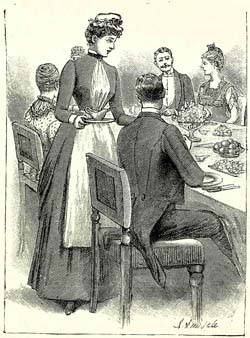
A Victorian Dinner Party
The Girl's Own Paper, 1887
|
The other type of etiquette involved the more nitpicky do's and don'ts of specific social interactions, such as social calling, the use of calling cards, social gatherings, dinners, invitations, and so forth. Calling, for example, was one of the primary activities of a Victorian woman's social life. She was expected to go forth nearly every day to pay calls upon those in her social circle, or else to be "at home" to the calls being paid upon her.
Such calls included all sorts of events, including teas, "at-homes," and more. If someone called upon you (even if you weren't "home" and they simply left a card), you were expected to return the call (and leave your card) within a few days. If you attended a dinner, you were expected to pay a courtesy call upon your hostess, again, within a few days. Again, keep in mind that most Victorian interaction took place in person; only at the very end of the era was it even possible to "call" by telephone!
Social calls require an entire school of etiquette surrounding the visiting card. These cards look very much like today's business cards, but fashions in visiting cards changed nearly every year. You might be expected to use white paper one year, ivory the next, cream the year after that - not to mention what fonts were and weren't considered acceptable! Mourning cards might have a large black border, or a small one - or, perhaps, they would go out of fashion altogether. Perhaps one reason these "rules of etiquette" changed so often was because they had nothing to do with courtesy or kindness, and everything to do with fashion - and Victorian lady wanted to let it be known that she wasn't "up" on the latest fashions! As Sophia Caulfeild puts it in her article, "The Foundation of All Good Breeding" (The Girl's Own Paper, 1880), such conventions are more a social ritual designed to determine whether a person actually belongs in your social circle. (Read more of Caulfeild's views on etiquette in the next column.)
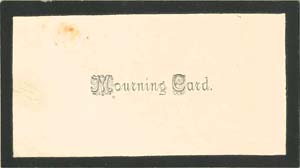
A Printer's Sample of a Mourning Card.
Note the heavy black border; this was one of the elements that often changed from year to year.
From a Victorian Scrap Album, undated
Perhaps it is because of this aspect of etiquette – the nitpicky rules of calling cards, social calls, and salad forks – that, today, we regard the lack of rules of etiquette as a virtue. Etiquette, we would happily declare, is stifling, destroying openness and creativity, and encouraging conformity at the expense of individuality. At the same time, we bemoan the rise of rudeness, and the rate at which outrage, hostility and antagonism are being codified into our society as virtues. We deplore the trolling and vitriol inspired by the anonymity of social media, and wonder why the world is moving in such an ugly direction. And since social engagements can cause discomfort (perhaps because, today, we receive absolutely no training in how to handle them), we increasingly opt to avoid them.
The problem with discarding "social conventions" as being outmoded and limiting is that it means that we are discarding the idea of limits as well. If there is no line, how can we complain when someone crosses it? If there is no rule, then how can we declare that someone who trolls, or incites, or is simply unbearably rude, is in the wrong? I don't know if the presence of "etiquette" in our society today would actively encourage people to be kinder and more courteous – but those qualities certainly don't seem to be encouraged by its absence!
Next Post: Victorian Writers Weigh in on Etiquette!
Find Out More:
- VictorianVoices.net Blog: What's the Point of Etiquette? Some Victorian Views
- The Foundation of All Good Breeding, by S.F.A. Caulfeild
(Girl's Own Paper, 1881)
- For more information, visit Victorian Etiquette and Social Occasions.
|
|
 Discover thousands of Victorian images in our