|
VVN Blog: June 7, 2026
The Perils of Reading
 Today, while enjoying my lunch, I engaged in an activity that would have raised quite a few Victorian eyebrows. At best, some might have considered me a "shallow brained and ignorant" girl, unaware of the harm I was doing to myself. At worst, they might have feared I might be contaminating my mental and moral fiber with a sort of evil "pitch" that would be difficult to rub off – and that might ultimately result in losing my moral compass entirely.
I was, of course... reading.
More specifically, I was reading fiction. Victorian girls were not discouraged from reading in general, but fiction was a new thing in Victorian society, and not everyone approved. Of course, it was fine to read classic authors like Dickens and Scott and Hugo, but... this new lurid, sensational, adventurous, romantic fiction? Who knew what damage it might do to the fragile female mind!
Actually, a number of Victorians thought they did know, and wrote strongly worded objections to this new, frivolous pastime. In 1884, for example, William Liddelow made the following comments in "On Reading and How to Profit By It," in The Girl's Own Paper:
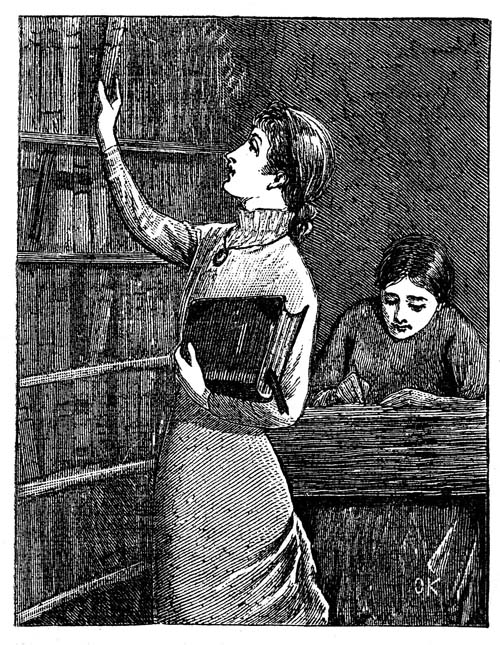
In 1881, we see women engaged in what looks like some pretty "solid" reading...
The Girl's Own Paper, 1881
|
First, a word or two on fiction as contrasted with more solid reading. Not so many years ago it was condemned by many religious persons as sinful, and a novel was to be shunned as worse than poison. We have grown wiser to-day, or else our fiction has grown better and purer. There is no need for the strictest person to put a veto on all tales and novels. Of the corrupting mass of sensational novels we do not speak. They, alas! find too many readers among young girls, too shallow brained and ignorant to know the harm they do themselves. Such books but pander to a morbid taste for information on subjects where surely ignorance is bliss indeed; they weaken the intellect, give false views of life, and deaden every pure or noble thought before possessed by their readers.
In Liddelow's view, one of the dangers to women is having their minds or imaginations overly stimulated by the excitement of fiction, though he notes, "What harms one will not hurt another. What will violently excite some will not move others. To some a larger amount of fiction reading is safer, and perhaps more desirable, than to others." However, he reminds us that fiction is a luxury. "To read nothing else is as hurtful and unwholesome as it would be to live entirely on pastry or cake." But worse,
Read fiction only, and the mind will be light, superficial, lacking firmness and decision, incapable of judging, of forming an independent opinion, listless, vacant. Read but some solid reading, and the mind must grow in strength and compass, capable of thinking, of judging for itself; capable of receiving new ideas and of forming them as well.
Liddelow isn't alone. In 1885, an anonymous writer in The Girl's Own Paper expresses concerns about the danger of fiction – or at least "bad" fiction:
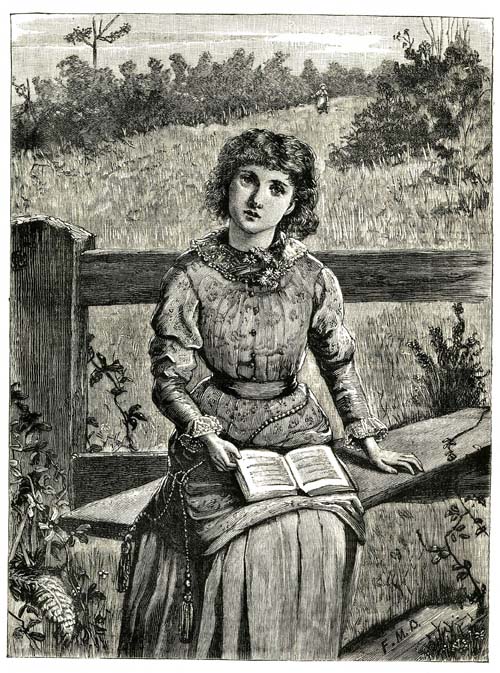
In 1885, some might wonder - is she enriching her mind or eroding her morals?
The Girl's Own Paper, 1885
|
A man cannot touch pitch and not be defiled - foul thoughts lie in the memory, and will not be ousted - the constant observation of evil presented in a form which is in the least degree attractive, gradually and insidiously weakens, if it does not altogether destroy, the hatred of wrong which exists in a pure heart.
This same author, however, makes a statement that is as true today as it was in the 19th century:
[Certain authors'] object is to win converts to their own opinions, and they employ all subtle reasoning to advance their cause; their course is unhindered by pity or remorse; they have the privilege of approaching us in our quiet and private moments. Therefore, while bigotry and prejudice are as indefensible in the region of books as in any other region, it is necessary to be on the look-out lest the fact of a statement, or an opinion, being "in print" should seem a guarantee of its truth or righteousness.
Part of the concern about the reading of fiction (especially by women) was that it was a "luxury." Fiction was not considered to be particularly improving of the mind, and so, such an activity could only be regarded as purely recreational. Time spent on what many regarded as a frivolous activity was time a woman could have spent in worthwhile activities – activities, in particular, that benefited others. In 1892, Mrs. Molesworth notes,
If [fiction] is to fall into its right place as an influence for good on a girl, it should be looked upon as among the sweetmeats of her life; otherwise it not only unfits one for graver reading, and most probably interferes practically with duties not to be set aside; but it actually loses its own charm if indulged in too much, or at unseasonable hours. ...novel reading in the forenoon leaves one in a curiously unready and desultory condition for the day's work; and sitting up late at night over an interesting or exciting tale is equally sure to make one's brain unhealthy, tired, and listless.
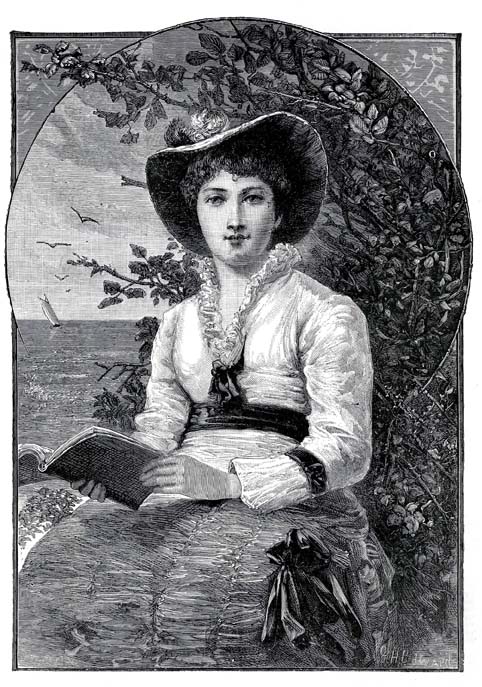
By 1888, one doesn't feel that this lady has any concerns about her reading habits...
The Girl's Own Paper, 1888
|
Ironically, Maria Louisa Molesworth wrote at least 100 novels and stories for children and adults! Still, Mrs. Molesworth also might be writing about issues of concern to many today when she points out,
...there are a great many novels that are not good, where no real belief or nobility of principle underlies the cleverness, which leave a young mind confused as to what is "good," or what the writer means one to think so; or, worse still, insinuates a strange chaotic distress as to whether right is right any longer, or wrong, wrong.
One of the most vehement arguments against fiction appears in the "Family Parliament" column of Cassell's Family Magazine, which offered for debate the question, "Can Fiction Be Made a Power for Good?" This clearly implied that fiction certainly wasn't considered a power for good yet; the question is, can it become so? Even the writer arguing in favor of fiction had little positive to say. As for the writer arguing against...
I am quite prepared to prove that fiction as it exists does an incalculable amount of harm... I trust I shall be able to convince the Family Parliament that fiction even of the best type generally does more harm than good: that it is, in fact, a potent source of evil....
Fiction regarded as a moral force and as a means of amusement may well be considered together, for it is beyond dispute that the chief object of writers of even the highest type of fiction is to amuse, and that novels and stories are read not for the sake of the moral lessons they may indirectly inculcate, but for the amusement and recreation which they afford. Novels do amuse - this cannot be denied; but herein lies an insidious source of danger, especially to the young. The charm which fiction exercises over some minds is so great that in its favour the duties of life are neglected, study is set aside, needful and healthful exercise is forgotten. Boys and girls, young men and women, ay, even fathers and mothers of families, oftentimes yield themselves so readily to the absorbing influence of fiction, that it grows to the dimensions of a baneful giant, overshadowing them wheresoever they go, wasting precious hours, and influencing for evil their whole career in life...
Boys' minds are naturally too full of the love of change and of the spirit of discontent; girls' minds are too prone to high-flown fancies and romantic thoughts, to need the unnatural stimulant in the same direction provided by fiction. I firmly believe that if we could only see one tithe of the actual and positive harm, the sin and misery, which has resulted from the spirit of unrest caused by excessive novel-reading, we should be appalled.
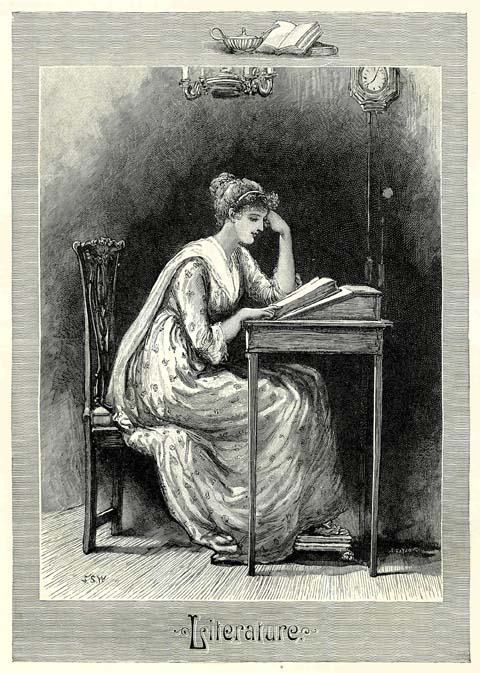
By 1892, the concept of "Literature" is embodied in the image of a woman reading - so much for the naysayers!
The Girl's Own Paper, 1892
|
Now, isn't that just a classic example of the Victorian mindset? Stuffy, prudish, repressive, opposed to any sort of modern advancement, condescending toward women – how much more "Victorian" can it get? This is the sort of article that helps convince people that this was how Victorians thought.
Except... it wasn't. The very fact that this article exists is proof that the author did not share the "mindset" of his day. Rather than being a classic example of Victorian thinking, this is a rant, a reaction to the fact that the rest of the world isn't moving in the direction this author desires. The vast majority of Victorians thought otherwise. That's not just my personal deduction; a subsequent issue ran examples of reader responses to the debate, and 83 readers supported the "pro fiction" side, with only 11 supporting the "con" side.
We have the advantage, today, of knowing how the story ends. We know that Victorians adored and embraced fiction; they couldn't get enough of it. Warnings like those above fell on deaf ears. The publication of novels exploded on both sides of the pond, and magazines devoted larger and larger chunks of space to short fiction and serialized novels. Most of the categories we hold dear today made their appearance in the Victorian era, including mysteries, romance (of a sort), historical fiction, science fiction, Western cowboy fiction, and more.
However, though the voices that sought to warn readers of the "dangers" of too much fiction were doomed not to get very far, one does feel a certain familiarity about one of Mr. Liddelow's comments. He writes, "It seems as though our age were too busy, our lives too full of hurrying activities, for solid, detailed book reading. Everything must be condensed, our knowledge of men and things must be swallowed in gulps; we have no time to quietly digest them in detail."
I can't help but wonder what he would have thought of Twitter...
Find Out More:
- On Reading, and How to Profit By It, by William A. Liddelow
(Girl's Own Paper, 1884)
- How to Read
(Girl's Own Paper, 1885)
- On the Use and Abuse of Fiction, by Mrs. [Maria Louisa] Molesworth
(Girl's Own Paper, 1892)
- Can Fiction Be Made a Power for Good? (Debate)
(Cassell's Family Magazine, 1882)
- Can Fiction Be Made a Power for Good? (Readers respond)
(Cassell's Family Magazine, 1883)
|
|
|

 Discover thousands of Victorian images in our