 Let's start wrapping up this discussion of "myths of the Victorian woman" with a look at the last few lines of the example we've been reviewing. Here we're told: "[Women] were generally controlled by their husbands. Women's roles in the 19th century were encompassed by the domestic sphere. They were largely in charge of domestic duties, such as raising children and housework, and were confined to their homes, while men participated in public duties, such as politics and commerce."
Again, a big problem with this statement is the generic use of the term "women." It is true that, in 19th century America, the majority of women (or at least married women) were what we would term "housewives." Women could and did work in America, but not to the same extent as in Britain. One reason for this was location. As noted in the first installment of this series, the majority of the US population lived in rural areas – farms, small towns, and, often, very remote locations. It's not easy to work outside the home if you're half a day's drive by buckboard from the nearest town.
Britain, conversely, experienced a huge migration of population from the country to the cities in the 19th century, and that included thousands of women seeking jobs. For the poorer classes, every penny counted, and it was often more important for a wife (and even the children) to bring in additional income than to keep the house clean. So while the "domestic sphere" encompassed many Victorian women, it certainly didn't encompass all of them.
Keeping a home and raising children was, again, generally the role of a married women. We might include widows in that category, as a widow might have children to care for – but she might also need to work as well, no longer having a husband to support her. And, as I've mentioned before, Britain often had a shortage of men, meaning that many British women had no hope of ever marrying and becoming a "housewife."
The quote is a bit more accurate in saying that women were "largely in charge of domestic duties." This at least avoids the suggestion that such duties were only handled by women, or that all women handled them. As we've already seen, women were involved in a great many other activities besides housework and child-rearing. In the 19th century, women were artists, writers, explorers, business owners, doctors, nurses, pharmacists – and, of course, servants, factory workers, shop workers, and employees of just about any type of industry imaginable. (Victorian women were also engaged in plenty of criminal activity!)
What should raise one's eyebrows, however, are two nasty words in this statement: "controlled" and "confined." Were women "generally controlled by their husbands" in the 19th century? (Once again, one needs to rule out single women from this statement, whether spinsters or widows.) It depends on the definition of "control."
From a purely legal standpoint, the word might be accurate, as, for most of the 19th century, the husband was not only legally the head of the household, but the only legally recognized individual in that household. Prior to the various Married Women's Property Acts in Britain and America, a wife was "covered" by her husband's identity, and had no legal standing. She could not file a lawsuit, write a will, buy or sell property, or control the custody of her children. So in a very real sense, a husband legally "controlled" every aspect of the household.
However, there's a difference between legalities and personalities. There is no doubt that a great many husbands, on both sides of the pond, took full advantage of their legal rights to control their wives and children, and more importantly, their wives' money. If they didn't, there would have been no need for all those Married Women's Property Acts. I also have no doubt that a great many husbands treated their wives fairly and kindly. There is no blanket, one-size-fits-all definition for human behavior. It's also important to note that it was up to men to change the laws that were unfair to women, and they did. For example, one attempt in the House of Commons to pass a suffrage bill in 1875 saw the vote at 152 to 187 (with Prime Minister Disraeli voting in favor of the bill). That suggests a great many men were attempting to make changes.
The word "control" suggests a situation in which one cannot take action without the permission of the controller. That, too, undoubtedly occurred in some Victorian homes, but was it true of all of them? In reality, a woman was generally considered to possess her husband's "authority" to make purchases, hire servants and pay them, and do what was necessary to manage the household and children, without having to obtain "permission" for every action. Most husbands were far too busy with other matters to try to micromanage the home as well. The 19th century saw the dawn of the "how-to" article, and women's magazines abounded with advice on how to make decisions and choices in just about every area of life – with no suggestion that women were not, in fact, permitted to make those choices.
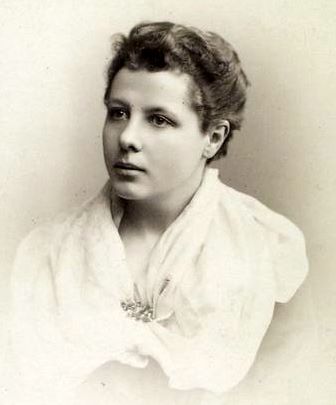
Annie Besant as a young woman
(Courtesy of Wikipedia; undated)
|
The other pesky word here is "confined," as in "[women] were confined to their homes..." Again, one wonders just what the author means by this term. Cornell University states that "Confine means to imprison or restrain someone, to keep them in a place, especially in a prison or jail..." So were women literally imprisoned in their homes, unable to leave without the consent of their espoused jailor?
Well, let's start with the question of whether, in fact, men had the legal right to, literally, "confine" their wives – and the answer is... drum roll, please... YES. As the American magazine Demorest noted in 1879, "With... a few states excepted... the married women of this country are to-day under the provisions of the common law, which not only deprives her of all property, but permits her husband to inflict on his wife 'proper personal chastisement,' and to become, if he pleases, her jailer and lock her up or even chain her, as was recently (1877) done in England by a man in Spilsby, who was dismissed without punishment, though he had kept his wife chained to the wall for twenty-four hours, as 'the courts of law permit a husband to restrain his wife of her liberty.' (Blackstone, Com., p. 445)."
It's interesting that an American magazine could only find a British incident to cite as an example here, but since American law typically followed British common law, let's see what that was all about. Demorest (which was a fairly progressive magazine) didn't tell its readers the whole story. According to Annie Besant, author of Marriage, As It Was, As It Is, and As It Should Be: A Plea for Reform (London, 1878), while a husband was permitted to restrain his wife, there had to be a reason for it, such as "gross misbehaviour" (Blackstone, p. 445).
If the wife squanders his estate, or goes into lewd company, he may deprive her of liberty" (Comyn's Digest, under "Baron and Feme"). Broom says that at the present time "there can be no question respecting the common-law right of a husband to restrain his wife of her personal liberty, with a view to prevent her going into society of which he disapproves, or otherwise disobeying his rightful authority; such right must not, however, be exercised unnecessarily, or with undue severity: and the moment that the wife by returning to her conjugal duties, makes restraint of her person unnecessary, such restraint becomes unlawful". In the year 1877 a publican at Spilsby chained up his wife to the wall from one day to the afternoon of the following one, in order, he said, to keep her from drink; the magistrates dismissed him without punishment. It may be argued that a woman should not get drunk, go into bad company, &c. Quite so; neither should a man.
Note that key statement: if the wife is not actively engaged in a form of "gross misbehaviour," the type of imprisonment that was inflicted by the pub owner at Spilsby would be "unlawful." (There is a certain irony in a pub owner objecting to his wife drinking.) Thus, it was not, in fact, legal for a husband to "confine" his wife, in the accepted definition of the term, simply at will or on a whim, with no legally demonstrable reason. And logically speaking, if you actually want your wife to manage your household, cook the meals, handle the servants and raise the children, "confining" her to the home is rather impractical.
It's also clear that the term "confinement" can only apply to married women. It cannot be said of single women, on either side of the pond, that they were in any way "confined" to the home. That includes the hundreds of thousands of women who worked outside the home, or attended colleges or universities, or perhaps simply had no need to earn a living. In reality, 19th century women – married or single – spent great amounts of time outside the home, handling errands, marketing, social calls, or simply visiting an art gallery or taking a walk in the park.
About the only way this statement makes sense is to assume that the author is seeking to contrast the Victorian wife, who is less likely to be in the workplace or political arena, with her husband, who is engaged in "public duties, such as politics and commerce." This, however, is not "confinement." One might even go so far as to say that many Victorian women "confined" their activities to the home sphere, but this, again, is not the same as being confined. Women were not prisoners in their homes in the 19th century – and a great many were, in fact, engaged in those public duties that the author ascribes solely to the male.
The quote we've been discussing would have been far more accurate if, from the beginning, it had referred to "wives" rather than "women." Annie Besant makes a key point in her book: "The difference between men and women in all civil rights is, however, with few, although important, exceptions, confined to married women; i.e., women in relation with men. Unmarried women of all ages suffer under comparatively few disabilities; it is marriage which brings with it the weight of injustice and of legal degradation."
Besant's book is an eye-opener, and we'll offer some excerpts from it in the next (and final) installment in this series. The legal situation for a married woman in the 19th century could be pretty grim – but it's important to note that this wasn't a situation specific to the 19th century. Rather, it was the result of legal doctrines that had been in place for centuries. What made the 19th century different was not that women lacked rights. It was that in the 19th century, these laws at last began to change for women – and women began to enjoy, for the first time, the range of rights and freedoms we've learned to take for granted today.
Find Out More:
-
The Law in New York as it Relates to the Family: Married Women's Rights, by Lillie Devereux Blake (Demorest, 1879)
- https://www.victorianvoices.net/ARTICLES/Demorest/Dem1879/Dem1879-Law-WomensRights.pdf
-
The Victorian Woman: Laws and Legislation
- https://www.victorianvoices.net/topics/women/laws.shtml
-
Harper's Magazine: Editor's Historical Record, 1875
- https://www.victorianvoices.net/ARTICLES/Harpers/H1875B/H1875B-Events.pdf
- (see page 2)
- Marriage, As It Was, As It Is, And As It Should Be: A Plea For Reform, by Annie Besant (London, 1878)
- https://en.wikisource.org/wiki/Marriage,_As_It_Was,_As_It_Is,_And_As_It_Should_Be:_A_Plea_For_Reform
- This book is well worth a look. It makes the marvelous point that there are disadvantages for the man to be the only "legally" recognized individual, citing a case in which a woman attempted to set fire to her husband's house with the full intent of burning him alive – but she could not be found guilty because she and her husband were, legally, the same person, so she was not, in effect, burning down someone else's house!
- Cornell University: Definition of "Confine"
- https://www.law.cornell.edu/wex/confine
Read the Entire "Myths of the Victorian Woman" Series:
|
|

 Discover thousands of Victorian images in our