 Continuing on with the subject of "myths of the Victorian woman," let's look at two more statements from our quote: "[Women] could not vote [and] did not have legal rights to their children."
Well, even that first statement isn't exactly accurate, particularly if we assume that this quote is referring primarily to women in America. While the 19th Amendment wasn't ratified until 1920, women gained the right to vote in several states well before the turn of the century. The first territory to grant voting rights to women was Wyoming, in 1869. By the end of the 19th century, women could vote in six states and territories - and by 1920, they could vote in more than half the US states and territories. In Britain, some women could vote in local elections, but not in national elections.
With respect to the women's vote in Britain, my primary quibble is with the implication that women were denied the vote simply because they were women. It is true that the Reform Act of 1832 did specifically exclude women by officially defining voters as male. However, what is less often mentioned is the fact that, during the 19th century in Britain, a large percentage of British men couldn't vote either.
From medieval times to the early 20th century, British voting rights were tied to property ownership. It's estimated that, in 1831, only 200,000 to 400,000 British males had voting rights. By the 1880s, at least 40% of British males (that's nearly half) were still disenfranchised. This means that the majority of the British population (counting in the female half) had no say whatever in the governing of their country.
My second quibble, thus, is with the emphasis placed on the 19th century itself, as if it were somehow an aberrant island in the stream of time. Lack of voting rights, for men or women, wasn't just a 19th century problem; again, it arose from laws dating from the Middle Ages, and wouldn't be resolved until nearly a quarter of the way into the 20th century. It would be far more accurate to state that, in Britain, women lacked the right to vote until the 1920's.
Indeed, they might not have gotten it then - if not for the work of women in the 19th century. The women's suffrage movement was born in the 1840s, and never stopped fighting for the franchise. In 1918, Britain finally granted full voting rights to all males over the age of 21, regardless of property ownership, and to women over 30 who were either property owners or married to property owners. Full suffrage for women didn't come about in Britain until 1928. In America, the 19th Amendment was made law in 1920, guaranteeing that "the right of citizens of the United States to vote shall not be denied or abridged by the United States or by any State on account of sex." (Note, again, that by this time, women could already vote in over half the states.) So it's quite possible that, if it weren't for the work of those ladies of the Victorian era, us ladies today might still be fighting for the right to vote!
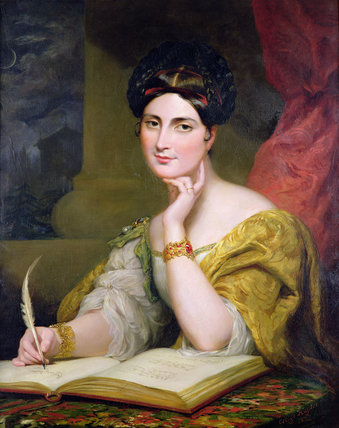
Social reformer Caroline Norton.
Portrait by Sir George Hayter, 1832
(courtesy of Wikipedia)
|
The statement about women's lack of custody rights to their children is a bit more complicated. It's partly true and partly not. Nor, like most social issues of the Victorian era, is it purely a 19th-century problem. Like the issue of married women's property rights, it stems from British common law, based on Roman law, that established the man as not only the head of the household but the only legal adult entity of that household. It was part of the problem of "coverture," the notion that a married women's identity was "covered" by her husband, so that she had no legal identity of her own. Under that same common law, children were literally the property of the husband - and these laws carried over into American law.
Nevertheless, it's still not strictly true to state that "women did not have legal rights to their children" in the 19th century. As early as the 1830s, many in Parliament were already working to reform this issue. (And let's note, for the record, that "many in Parliament" means, by definition, men.) What finally brought about the first much-needed reform act in this area was the campaigning of Caroline Norton, Lady Stirling-Maxwell.
Norton attempted to divorce her husband, George Chapple Norton, on the grounds of mental and physical abuse. Her husband responded by attempting to show that Caroline had committed adultery with her friend Lord Melbourne (the Prime Minister!). George's suit failed - but even though Caroline was cleared of any hint of adultery, she was unable to win a divorce, and lost custody of (and access to) her three sons. She launched a campaign arguing "for the natural right of mothers to have custody of their children" (Wikipedia), and in 1839, based on her efforts, Parliament passed the Custody of Infants Act.
According to Wikipedia, "This changed dramatically the way that custody of the children after divorce was granted. If previously in the majority of the cases the child custody was awarded to the father, the Custody of Infants Act 1839 permitted a mother to petition the courts for custody of her children up to the age of seven, and for access in respect of older children. This was the starting point of a new doctrine in the area of child custody, called Tender Years doctrine."
Let me take a brief moment here to editorialize. We are so often told that Victorian women were meek, mild, helpless, house-bound creatures who were utterly barred from the public realm and, especially, the realm of politics. And while Victorian women made great strides in all areas of women's rights in the 19th century, this was early days, and women had a lot fewer rights and options tha they did in, say, the 1880s and 1890s. Yet here's an Act of Parliament that is the direct result of one woman's determination to right a wrong - which shows that women could accomplish quite a lot even in the early part of the 19th century!
Now, despite this Act, the "default" was still for the father to retain custody in the event of a divorce or separation. A father could also establish someone other than his wife as the guardian for his children after his death. For a mother to gain custody or even access (i.e., "visitation rights") to her children, she had to petition the court, and also prove that she was of good character. If no such petition were made, the father automatically retained those rights - and one can assume that, for many, financial difficulties might preclude a woman's ability to launch such a legal action.
Nothing much changed in this area in Britain until 1873, when the Act was expanded to include children up to the age of 16. This Act also removed restrictions on women found guilty of adultery. Note that this Act follows closely upon the Married Women's Property Act of 1870, both of which were partly the result of continued campaigning by Caroline Norton. The Married Women's Property Act of 1882 finally gave married women the same individual rights and legal recognition as single women, and in 1886, the Guardianship of Infants Act gave women the right to become their children's guardians on the death of the father. However, it wasn't until 1925 that an Act established equal custodial rights for both parents!
In the US, laws followed a similar pattern, and were usually handled on a state-by-state basis. Women in the US weren't consistently granted custody in the case of divorce until the early 1900s, and the question of "who is best fit for custody" remains an issue to the present day.
Again, these were not problems isolated to the 19th century. Rather, they were problems that gave birth to 19th-century solutions - many of which didn't come to full resolution until the 20th century. These are both excellent examples of how "Victorian" problems, inherited from their ancestors, evolved into "modern" problems passed on to their descendants (you know, us!).
Find Out More:
- Caroline Norton
- https://en.wikipedia.org/wiki/Caroline_Norton
- Child Custody Laws in the United States
- https://en.wikipedia.org/wiki/Child_custody_laws_in_the_United_States
- Victorian Women's Legal Status
- https://www.weber.edu/michaelwutz/womens-legal-status.html
- Women's Suffrage in the U.S. by State
- https://tag.rutgers.edu/wp-content/uploads/2014/05/suffrage-by-state.pdf
- A PDF file from Rutgers University's Centre for Women and Politics, listing the dates in which various states and territories granted women the right to vote before the ratification of the 19th Amendment in 1920.
- Custody of Infants Act 1839
- https://en.wikipedia.org/wiki/Custody_of_Infants_Act_1839
Read the Entire "Myths of the Victorian Woman" Series:
|
|

 Discover thousands of Victorian images in our