|
VVN Blog: March 17, 2026
Myths of the Victorian Woman, Part II:
Property Ownership
 Now that we've dispensed with the question of whether women "could" work in the 19th century, let's look at another glaring myth-perception in last post's example: "Women... in the 19th century... could not own property."
Once again, the two key problems with this statement are the generic use of the term "women," and the unspecified use of the term "19th century." If we are to take the statement at face value, then, logic tells us that no women could own property at any time during the 19th century (and let's just assume this is meant to be true of Britain and America).
In reality, by the 19th century, women had been owning property in Britain for hundreds of years (and for at least a couple of hundred in America). The key problem with the statement above is its failure to specify that this restriction applied only to married women. From the 13th century onward, British common law recognized an old Roman law that specified, basically that the man was not simply the head of the household but literally the owner of the household, and everyone within it (including wives and children). In British common law, this translated into the law of "coverture," which declared that a married couple was a single entity, that entity being, legally, the man. The legal identity of the wife was "covered" by that of her husband.
And that, Dear Reader, meant that, for a very long time, when a woman in Britain married, she lost every bit of property she might formerly have owned. If she owned land, it became her husband's land. Her money, and any other form of property – such as personal possessions, jewelry, and in later centuries, intellectual property such as a copyright – belonged to him. Any income she might receive from working, inheritance, or other sources (such as income from a property) was her husband's.
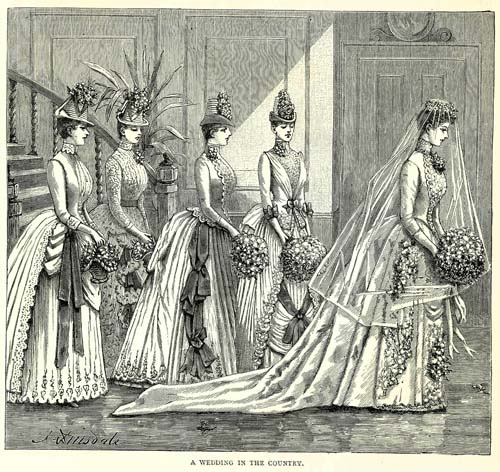
This bride is fortunate: the year is 1887, and she no longer has to worry about losing title to her personal and real property, thanks to the Married Women's Property Act of 1882!
The Girl's Own Paper, 1887
This element of British common law passed into American law, so for quite some time, married women in America also lost the rights to their money, land, and any other possessions. However, many lawmakers on both sides of the pond recognized that this wasn't exactly fair, and a variety of mechanisms were used to bypass the law. If, for example, a woman's family chose to give her some property as a dowry, it was often placed into a trust, so that the husband had no rights to it. Of course, this meant that the wife didn't control it either – but at least the land and its income remained available for her use, and the trust often ensured that she couldn't be forced to sell the property and give the income to her husband.
Here's where a bit of logic should kick in: Deplorable as it may seem that a husband could claim all of the assets that his wife held before her marriage, this could not happen if a woman weren't able to own property in the first place. If women "could not own property" in the 19th century, there would have been nothing for husbands to "take." The very existence of the law that allowed husbands to claim their wives' land, money, and personal possessions is in itself all the evidence we need to demonstrate that women of the 19th century could, and did, own property.
So now we get to the pesky term "19th century." As I mentioned in the previous post, this is either referring to the Victorian era (1837-1902) or to the entire 1800s. Either way, the statement that "women couldn't own property in the 19th century isn't accurate – quite simply because, once again, the 19th century is when all that began to change.
In this case, things began to change in America first. As with many laws affecting women's rights in the US, they changed on a state-by-state basis. The first state to institute a "Married Women's Property Act" was Mississippi, in 1839; it enabled married women to own but not control their own property. By the end of the 1840's, most other states had also enacted "Married Women's Property Acts," with a few holdouts waiting until the 1860's. (Note that, by 1840, the "Victorian" era had just begun, while the 19th century as a whole wasn't even half over.)
Britain was a bit slower to address this issue. The first "Married Women's Property Act" was enacted in 1870, and it was generally considered to be far from perfect. As I note in How to Survive in Victorian Britain (plug, plug!),
The first 'Married Women's Property Act' was issued in 1870, which gave a woman the right 'to any wages or earnings gained by her separately, and of any money ... in her name in the savings-bank, the funds, a joint-stock company, or any industrial or friendly society', or money she inherited, plus rents and profits from land inherited or gained through a deed (not to exceed £200). Your husband still has rights to all money, jewellery, or property you had at the time of marriage, anything exceeding that £200, and lands you acquired some other way, as well as any gifts you receive. 'If a working woman managed out of her earnings to purchase, say, a mangle, it was her own; but if any one gave it to her ... it was her husband's.'
A much-improved Married Women's Property Act was issued in 1882. This decreed that 'A married woman ... shall have the same power of acquiring, holding, and disposing by will or otherwise, of any real or personal property as her separate property ... as if she were [single].' Your money was now your own. You could bring an action against your husband, and vice versa. Spouses could give evidence for or against one another in court. You could bring a criminal complaint against your husband as long as you were no longer living together, and the injury didn't occur while you were. On the downside, it made you responsible for your own debts. If you run up a bill at the dressmaker's, your husband isn't liable for it. Plus, if you were married before 1883, when the Act went into effect, the assets your husband had already acquired remained his. [Quotes are from "A Social Revolution: The Married Woman's Property Act, 1882," Cassell's Family Magazine, 1883.]
But here's the key point: In the 19th century (and not even for all of that), only married women were unable to own property. Single women – whether "spinsters" or widows – were considered "femes soles" and could own property, inherit property, retain the income from their property, rent property, sell property, and leave their property to whomever they wished. And while there were certainly a great many married women in Victorian Britain and America who were adversely affected by the pre-MWPA era, there were also a very great many unmarried women who weren't affected at all. And so, a great many women could and did own property throughout the 19th century.
Ironically, in Britain, the fact that women did own property fueled one of the primary arguments in favor of women having the vote. Until the early 20th century, voting rights were linked to property ownership. That meant it wasn't just women who didn't have the vote; the majority of British men didn't have it either. In 1867, John Stuart Mill argued that since property was the basis of representation, women should not be disqualified, having "all the responsibilities and all the privileges of property except that of voting. They are liable for debts, can enter into contracts, can purchase, alienate, and devise, sue and be sued."
The 19th century was not a period when "women couldn't own property." Women could – and did. However, for much of the era in Britain, and a small part of the era in America, married women still faced the loss of their property and finances. This wasn't a "Victorian" issue or even a "19th century" issue – it was an issue that began in Britain in the 13th century and only ended in the 19th. Once again, the myth-perception is that somehow, this was a Victorian evil – while the reality is that it was yet another earlier evil that the Victorians were the first to remedy.
Find Out More:
- A Social Revolution: The Married Woman's Property Act, 1882 (Cassell's Family Magazine, 1883)
- Questions of the 19th Century
(Godey's Lady's Book, 1867)
- Includes an excerpt of John Stuart Mill's speech in favor of women's suffrage.
- Things You Might Not Know About Being a Spinster in Regency-Era England, by Amy D'Orazio
- https://www.quillsandquartos.com/post/things-you-might-not-know-about-being-a-spinster-in-regency-era-england
- Though not quite "in period" for this post, here's a fascinating little detail about women and property ownership in the Regency period (1810-1820, or 1810-1837, depending on your point of view): "In the late eighteenth century, a tax was proposed which specifically targeted spinsters. Any woman over the age of 27 was to be taxed 6% of the value of her land, property, fortune or other assets. Any woman who failed to accurately report the extent of her financial worth would be required to forfeit 25% of it to the Crown. The proposal was meant to discourage wealthy, unmarried young ladies from electing to remain unwed."
- Married Women's Property Act 1870 [UK] (Wikipedia)
- https://en.wikipedia.org/wiki/Married_Women%27s_Property_Act_1870
- Married Women's Property Act 1882 [UK] (Wikipedia)
- https://en.wikipedia.org/wiki/Married_Women%27s_Property_Act_1882
- Married Women's Property Acts in the United States (Wikipedia)
- https://en.wikipedia.org/wiki/Married_Women%27s_Property_Acts_in_the_United_States
Read the Entire "Myths of the Victorian Woman" Series:
|
|
|

 Discover thousands of Victorian images in our