|
VVN Blog: July 21, 2026
How to Survive in Victorian Britain
 I'm interrupting my series on Victorian etiquette with a wonderful announcement: my new book, How to Survive in Victorian Britain (Pen & Sword Books) has just gone live on Amazon! So I thought I'd introduce it by sharing a few of the surprising things I learned about the Victorian era along the way. (In fact, I like to think this book is full of surprises – of which these are just a few!) Let's start with...
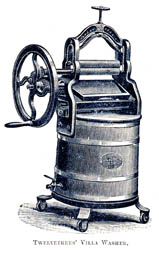
A Victorian Washing Machine
Cassell's Book of the Household, 1890
|
Our Friends, the Servants... That's actually the title of a series of articles that ran in The Girl's Own Paper in 1893, by which time it was becoming increasingly difficult to find "good" servants. Articles like these continued to try to convince young women that "service" was a worthy, noble, and highly paid profession – not like working in a factory or as a typist. But what surprised me the most was that, for most of the Victorian era, the majority of servants were employed, not by the wealthy and titled, but by average middle-class households. The Victorian era marked "the rise of the middle-class," especially from the 1850s onward. Such households sought a standard of living that simply couldn't be achieved without the help of at least one servant – and most households that employed servants did, indeed, employ only one. (BTW, a blog series on servants is coming soon!)
A great many of those households contributed to the rise of something else: suburbia. In the early 19th century, you pretty much had "town" and "country." As public transportation improved, however, it led to the rise of suburbs. In the suburbs, a middle-class family could afford a nice little home, and use a tram or omnibus to commute to one's job in "town." In due course, suburbs would be swallowed up by the ever-expanding "town," villages would become suburbs, and Victorians would begin to lament that the "countryside" was vanishing altogether! Rather like now...
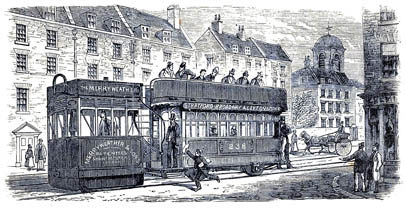
A Steam-Powered Victorian Tram: Making Commutes from Suburbia Possible!
Cassell's Family Magazine,, 1887
Laundry Day... If you're wondering why a middle-class household would need even one servant, you need look no further than laundry day (usually Monday). Doing laundry in the 19th century wasn't for the faint of heart! It surprised me to learn that Victorians did, in fact, have "washing machines." These began to appear as early as the 1860s; early versions looked much like a butter churn, but later versions featured an enclosed tub with paddles or agitators not unlike machines today. That might sound like great news for the Victorian housewife, except... those washing machines aren't powered by electricity. They're powered by you. Someone has to turn the crank to keep those agitators spinning (and laundry day goes on all day). Someone also has to fetch hot water from the boiler (which is built into the stove), and haul away the dirty water when the wash is done.
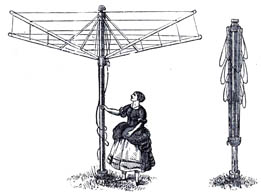
Victorian Clothesline
Cassell's Household Guide, 1884
|
As for drying one's clothes, if you've ever seen one of those back-yard clotheslines that looks a bit like a huge square umbrella, and folds up when not in use, well – that's a Victorian invention! If you don't have a yard, you'll need to hang clothes indoors to dry. You'll also need a wringer (generally built in to the lid of the washer) and a mangle for pressing the water from larger items, like sheets. You may be making your own laundry soap as well.
Live Long and Prosper... We've all heard that life expectancy was very short in the Victorian era (and it seems to me that just doing laundry alone would be enough to shorten one's life-span). Many articles and blogs still declare that "average" life expectancy was around 40 years. Fortunately, Google AI now provides a bit more accuracy by pointing out that these numbers are skewed by high infant and child mortality rates. Still, I was surprised to learn that in reality, if you did survive childhood, you had about a 1-in-3 chance of living to a ripe old age. Your chances were better, of course, if you lived in the country; mortality rates in the cities (and especially London) were far higher, due largely to unsanitary conditions and crowding that contributed to the rapid spread of diseases.
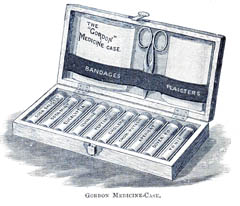
Victorian Medicine Chest
Cassell's Book of the Household, 1890
|
...But Avoid That Medicine Chest... Your chances of survival would probably improve if you stayed away from most Victorian "medicines." Victorian medicines were, in fact, kept in chests, not in cabinets on the wall; this made it much simpler to bring the medical supplies to the patient, especially if first aid was required. There were few "controlled substances" in Victorian Britain. One of the most noteworthy was arsenic, which became regulated in 1851; in 1868, the Poisons and Pharmacy Act regulated another 15 poisons. That doesn't mean you couldn't get them, though; it simply meant that to do so, you had to sign the Poison Book, and be known to the pharmacist (or to someone the pharmacist knew). A great many things we'd consider downright illegal today were readily available over the counter, including cocaine (there was nothing illegal about Sherlock Holmes' addiction!). "Coca" was readily available for a variety of ills, including seasickness. Though opium was included in the Poisons Act, it could be purchased over the counter until the 1920s, and was included in a variety of preparations, including "soothing" remedies for children. You might also find your medicine chest equipped with medications containing arsenic, belladonna, aconite, morphia, and more. If you wanted to fill your own cavities, you could buy a bit of mercury at the pharmacy and mix it with silver shavings – which might sound awful, but isn't much different from modern amalgams!
In the Event of Death... High mortality rates meant that Victorians had to deal with death on a regular basis. Perhaps it's not surprising that they evolved a number of formalized ways to do so, including the obligatory period of mourning for widows. This involved an elaborate set of requirements for the wearing of mourning – including crape veils that, it was said, might hasten the widow to her own grave (or at least make her exceedingly uncomfortable), because the black dye included arsenic and other toxic chemicals. Mourning attire (and the manufacture of crape) was big business in Victorian days, to the point that many writers urged women not to waste what scant funds they might have left just to observe the niceties of mourning etiquette. Mourning observations were very much a social thing; women of the working, domestic, and lower classes couldn't even begin to afford such things, and thus, fortunately, weren't troubled by it. And speaking of peculiar mourning observances...
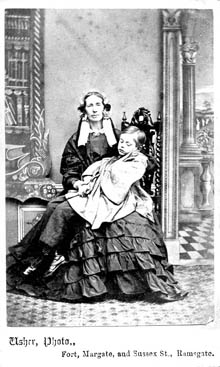
A Victorian Post-Mortem photograph
Courtesy of Wikipedia
|
You May Not Be Seeing Dead People... One of the things I expected to write more about was the custom of taking postmortem photos of the dead. Today, these photos just seem... well, creepy. But, I thought, surely they wouldn't seem unsettling to the families that treasured them, because, after all, that person probably died right there in the family's home, with the family about them, and the body would have remained in the household for several days before the funeral. So undoubtedly (I thought), the practice of taking and preserving a photo of that person wouldn't seem creepy at all at the time. Many modern articles declare that the custom arose because photography was expensive, and this was perhaps the only chance of preserving a portrait of a loved one.
However, things aren't always as they seem. While photography was expensive in the very early part of the Victorian era, it quickly became affordable; in addition, there's no indication that such photos were taken only by those too poor to afford a living portrait. In fact, postmortem photos often show families and homes that seem quite well-to-do. But the surprise was that no one talked about it. If this were a perfectly acceptable practice by Victorian standards, it would have been discussed openly in Victorian magazines, along with all the other things that one should (or should not) do upon the death of a family member. (Magazines don't hesitate to discuss hair-work, for example, and that's pretty creepy too.) If it were regarded as a quaint but harmless curiosity, it would be written up in magazines like The Strand, which covered customs that seem even more bizarre than this. This wasn't just my own finding; when I did come across a scholarly article on the practice, it, too, noted the absence of contemporary information on the topic – along with the fact that photographers who engaged in the practice seemed to find it distasteful.
Today, dozens of websites post images of what may or may not be "postmortem" photos (and a great many of these are being sold on Ebay). Fortunately, some excellent sites* can help you debunk photos of the not-so-dead. Put briefly, if someone has bright eyes and an expressive face, or is standing or sitting in a perfectly normal position, or is holding an object, that person isn't dead. A child with closed eyes is not necessarily dead (especially if standing up or holding an object); children blink. A grim-faced woman holding a sleeping baby isn't necessarily mourning; in Victorian days, one did not "smile for the camera." (Since you had to hold your position for several minutes, a "smile" would quickly start to look like a rictus grin.)
Mourning rituals, however, are for those who didn't survive in Victorian Britain – and my book is designed to tell you how you can. It offers tips on what to eat (or what you can expect to find to eat and where you'll find it), how to manage your home, how to deal with the many rules of social etiquette, how to entertain yourself (and your friends), what to wear, how to get around town, around the country, or even across the world, and much more. If you're planning to time-travel to the 19th century, you'll find this a most helpful guidebook – as will the armchair traveler. Corsets aside, there's a great deal to be said for the 19th century. It would certainly be an interesting visit; you might even decide you'd like to live there!
Find Out More...
- Debunking Victorian Postmortem Photographs
- https://rarehistoricalphotos.com/debunking-postmortem-photographs
- Victoran Postmortem Photos: The Myth of the Stand Alone Corpse
- https://dealer042.wixsite.com/post-mortem-photos
- Clearing Up Some Myths About Victorian "Postmortem" Photographs
- https://www.atlasobscura.com/articles/victorian-post-mortem-photographs
Find Out More About How to Survive in Victorian Britain:
|
|
|

 Discover thousands of Victorian images in our