|
VVN Blog: February 13, 2026
The Wild World of Victorian Valentines
 Do you send Valentines to friends and loved ones? If so, you're perpetuating a tradition that has its roots in the Victorian era. Celebrations of the feast of St. Valentine, of course, go much farther back; it became an official festival in the fifth century, replacing the Roman fertility festival of Lupercalia (and, needless to say, absorbing many of that festival's traditions). Chaucer, amongst others, declared in the 14th century that this was the day on which birds choose their mates, wooing and cooing.
The Valentine card, however, is purely a British Victorian development - in fact, the entire "greeting card industry" as we know it today began in Victorian times. It was born out of the introduction, in 1840, of the Penny Post - literally the first postage stamp. Prior to the Penny Post, the cost of the delivery of a letter in Britain was borne by the recipient, and was often pretty steep. Postage stamps made it possible for almost anyone to send a letter to any destination in the country. Once it was possible to send letters quickly and cheaply, one thing led to another, and... well, that's why we have Valentines today.
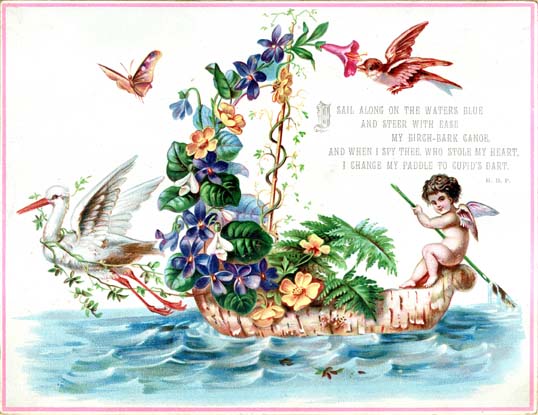
A classic Victorian Valentine. From a Victorian scrap album, undated.
For much of the Victorian era, Valentines were big business. Greeting card firms printed them by the millions, embellishing them with lace, diecuts, feathers (often supplied by Brazilian nuns), trinkets, charms, toys, jewelry, and more. One not-so-charming feature of many cards was the inclusion of a stuffed hummingbird (sometimes complete with a nest). Personally, I'm not sure I'd have been thrilled to receive a card with a dead bird on it, but considering that thousands of Victorian women wore dead birds on their hats, I suppose that to them, receiving one as a token of affection would seem perfectly natural.
Victorian greeting cards were generally printed as lithographs - which means the designs were literally etched in stone, one stone for each color to be printed on the card. In their heyday, the printing of Valentines alone employed thousands of women, not only in hand-painting and embellishing the cards and preparing them for shipping, but also in writing verses.
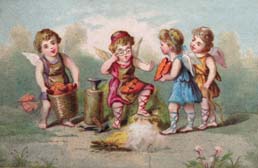
A Victorian Valentine trade card; this would have been sent with an
advertiser's message printed on the front or back.
Note that the cherubs are busy mending broken hearts!
From a Victorian scrap album, undated.
Victorian Valentines often included small gifts, such as jewelry, gloves, and other dainty and perhaps expensive items. However, Valentine’s Day was also apparently a day for the giving of gifts in general, especially to children! According to Ardern Holt, writing for The Girl’s Own Paper in February 1882,
Weeks before the fourteenth the local papers teem with advertisements of valentines for the young and old, rich and poor, from £100 to a halfpenny. But the real worshippers at the saint's shrine are the toy shops. What rocking-horses, bows, fishing-rods are prepared for leaving mysteriously on the eve of St. Valentine, when the little ones believe the bishop makes his rounds, his lawn sleeves stuffed with sweets. It is absolutely forbidden that the sender should put his name on the gift...
Not all Victorian Valentines were sweet and lovely, however. The era also gave rise to the so-called comic or "Vinegar Valentine." These first appeared in the 1840s and endured well into the 20th century. Vinegar Valentines were usually postcards, or printed on an inexpensive sheet of paper, and combined a rude caricature with an insulting verse or message. Such Valentines typically made fun of a person's appearance, character, or profession- or, in the case of "suffragist Valentines," the vote-seeking woman's lack of desirability.
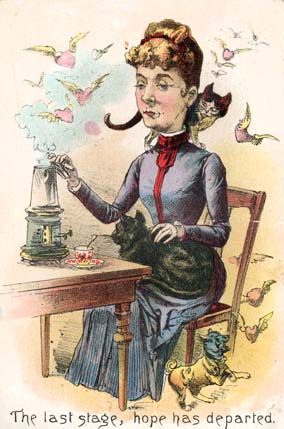 Until I learned about Vinegar Valentines, I never understood this particular card in my collection. It seems to be part of a series. Google Lens identifies it as, indeed, a Vinegar Valentine!
From a Victorian scrap album, undated.
|
Though many were cheaply made, Vinegar Valentines were also big business, and were published by such prestigious firms as Raphael Tuck and Sons. British and American post offices often refused to deliver the postcards, considering them inappropriate items to be sent through the post. Today, you can find a number of such Valentines on Ebay - just search on "Vinegar Valentines." Most of these date from the early 1900s, but they convey the general idea. One declares, "Don't be a snake in the grass. To be untrue to your friends is to be the meanest of reptiles." The image shows a serpent in the grass with a woman's head, surrounded by hearts. Another lampoons the would-be sportsman, declaring, "All day with his gun and his rod/After fowl or fish he will plod,/His breath it is bated/But we’ve heard it stated/All he bags is his pants, which is odd." Yet another depicts "The Meanest Man in Town," with padlocks on all his pockets, and a note declaring that "The Lord loves a cheerful giver, but you will never give him cause to love you." Still another suggests that the recipient goes too long between baths.
Allegedly, these cards were usually sent anonymously, though one assumes that the recipient would probably have had a pretty good idea of who the sender might be. But it's interesting to see that the power of anonymous messages seems to have brought out the worst in many people long before Internet comments and social media trolls - and that big businesses were more than happy to capitalize on this trend!
By the 1890's, many felt certain that the era of Valentines was over. In 1898, a poem in The Girl’s Own Paper lamented the "end" of the celebration of St. Valentine:
Lamented Saint! In olden days,
Recurring spring proclaimed thy praise,
And plighted friendship, gifts of worth,
Thy birthday hailed with happy mirth.
Then paper off'rings, tinsel gold,
Replaced the costly gifts of old;
Yet, at the postman's loud appeal,
Maid, mistress flew in eager zeal!
Alas! No more the flimsy show
Gleams in shop windows all a-row,
And empty, lonely is the shrine
Of kindly old Saint Valentine.
Such predictions of the demise of the Valentine, however, were premature, as we all know. Just as our cards today hark back to the Victorian images of hearts, flowers, birds, and lace, so too do they hark back to the Victorian love of profit. Even with all the electronic options available today, we still buy paper Valentines, and send them off with a postage stamp (though that now costs, not a penny, but a pretty penny!). Vinegar Valentines survived well into the early 20th century, and the practice of sending anonymous insults continues. We can thank Victorians for the Valentine’s Day card; we can thank human nature for the vinegar!
Find Out More:
- Fashions in Valentines, by Alexander Wainwright
(St. Nicholas, 1875)
- Buying Valentines (Cassell's Family Magazine, 1877)
- St. Valentine's Day, by Dora de Blaquière
(Girl's Own Paper, 1880)
- Valentines, by Ardern Holt (Girl's Own Paper, 1882)
- Vanishing Valentines, by William G. FitzGerald (The Strand, 1895A)
- "The Rude, Cruel, and Insulting 'Vinegar Valentines' of the Victorian Era," by Natalie Zarelli, Atlas Obscura, February 8, 2017
- https://www.atlasobscura.com/articles/vinegar-valentines-victorian
- This is a good article but, unfortunately, most of the images are not Victorian, dating instead from the early 20th century.
|
|
|
 Discover thousands of Victorian images in our