Simon Potter
|
There is no denying how much the public loves TV murder dramas, and how murder mysteries frequently top the best-selling book charts.
And that stems directly from our Victorian ancestors.
I've become absolutely fascinated by the daily lives, thoughts and attitudes of 'the ordinary people' in Victorian times, while researching and writing my new book, Lincolnshire's Victorian-era Murders, about my own quiet corner of England.
Trying to imagine life without telephones, radio, television and the internet whisks me away to a daydream, wondering how I might have survived in those circumstances, wondering if that would have been a better world than ours and wondering how people thought about society around them.
The rapid growth of newspapers and books fuelled by rising literacy rates and improvements in print technology gave people a taste for tales of foul and bloody murder. It was a way to escape the repressive atmosphere of strict morality, the 'stiff upper lip' attitude and insistence on good manners that Victorian society propagated; it was the gateway to an exciting glimpse into the forbidden dark underbelly of human depravity.
In an article about the perils of his job, the editor of the Lincolnshire Free Press wrote, in his newspaper's edition of 12 February 1850, 'If he does not fill his paper with news of importance, whether there be any or not, it is condemned for not being what it purports to be – a newspaper. If every paper does not contain a goodly number of suicides, horrible murders and melancholy accidents, it is a dull unwelcome sheet.'
When the 'Jack the Ripper' murders shook London, there was no impartial, cool and factual reporting. The rival newspapers seized the opportunity to profit, by out-sensationalising each other. The Whitechapel killings were whipped up into a frenzied Gothic narrative, more fiction than fact.
The police would not give any information to the press about their investigations, so reporters made it up. Criticising the coverage, politician Lord Cranbrook, a former Home Secretary wrote, 'More murders at Whitechapel, strange and horrible. The newspapers reek with blood.'
1888's sensationalism of the Ripper was nothing new. There were frequent examples in the earlier 19th century local newspapers that I read to research the cases that make up my new book.
In 1842, for example, The Lincoln, Rutland & Stamford Mercury described the murder of Mary Lilburn, as 'more revolting than almost any that are to be met within the records of crime. It is causing great excitement in Lincoln.'
It was not that exciting, though. She was just hit over the head with some sort of butcher's implement, by her husband.
Readers of the Spalding Free Press were told in 1876 that, 'The quiet little town of Horncastle has for many years been undisturbed by anything tragic or sensational; and yet in the past few months it has been the scene of startling events, which have made men quake and shudder: and it seems as if some evil spirit had made a settlement among the peaceful and respectable inhabitants.'
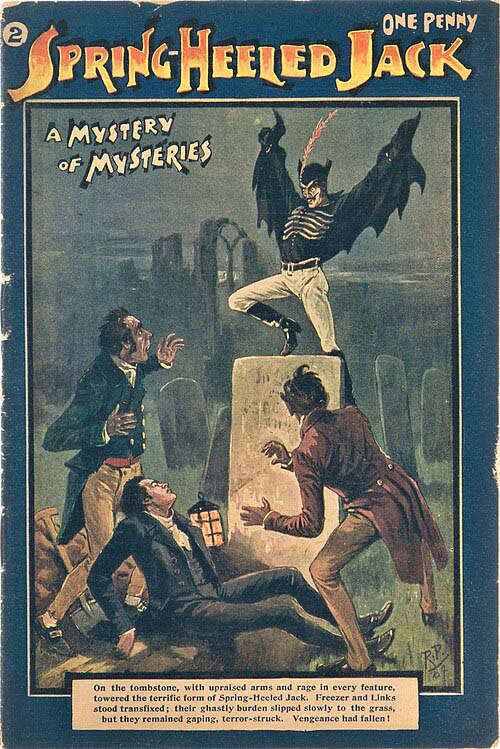
Spring Heeled Jack as depicted in the English Penny Dreadful Spring-Heeled Jack #2, Aldine Publishing, 1904.
Courtesy of Wikipedia
|
After explaining that was the case because there had been three serious fires and a 'rather large number of accidents and cases of misadventure', the newspaper stated that the murder of wheelwright and part-time police constable Thomas Gell had affected the God-fearing local Christians badly, 'as they shudder, and recount the story with bated breath, and with terror in the eye, and bewilderment in the brain, they feel they are but seeing some vision of the night, and that a foul demon had suddenly appeared to them, leaving his horrid sepulchral laugh still ringing in their ears, and his gloomy presence, like a noxious vapour, still around and among them.'
Why did the newspapers write like this? The answer is simple – it was what their readers wanted, it sold more newspapers and it made them more money.
Why the fascination with gruesome crime took off like wildfire is open to speculation, and many have speculated. Reading these tales was a form of escapism from a not very-pleasant, hard life.
Alongside the newspapers, the 'Penny Dreadfuls' spread like wildfire, usually telling accounts of fictional murders, and gave the world Sweeney Todd, the Demon Barber of Fleet Street, amongst other classics.
Sometimes they told over-dramatised accounts of real-life crime and are to blame for the fact that what we think we know about highwayman Dick Turpin is very far removed from the crimes that the man actually committed.
Then, of course, there was Spring-Heeled Jack. They turned a real-life sex pest into somebody who had claw-like hands, pointed ears, glowing eyes, horns and the ability to breathe blue and white flames into his victims' faces. Oh, and he could jump from the pavement to a roof or over a wall to make his escape.
The public loved it.
Murder became big business; murder became entertainment and that has mushroomed into what we have today. And it was the Victorians who started the trend.
From all that reading grew a thirst for public executions. They attracted bigger crowds than anything else in market towns up and down England.
The Victorian masses loved little better than the party atmosphere generated by a bellyful of beer, some rude songs about the convicted murderer and the spectacle of the miserable wretch being put to death on the gallows. Thousands used to gather for the occasion, often travelling many miles for the pleasure.
In 1817, public executions in Lincoln were switched to the roof of the Cobb Hall, within Lincoln Castle, so they could be seen from all the nearby streets, allowing more people to get a good view. Executions were usually scheduled for market days, when the city would be at its busiest.
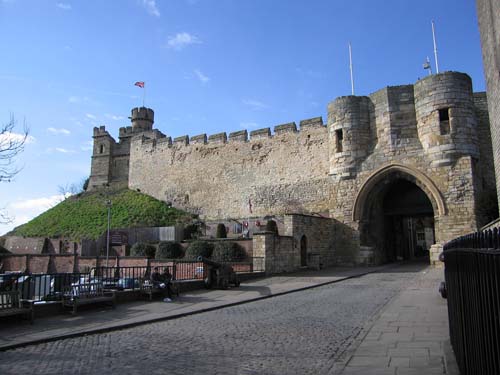
Lincoln Castle Today
Photo by M. Dimitrij, courtesy of Wikipedia Creative Commons License , 1897
That meant there could be bigger crowds, all of them cheering and baying for the killers' blood. The pubs did a roaring trade and entrepreneurs sold 'Murder Broadsides', usually single sheets of newsprint, telling a sensationalised account of the crimes committed by the person being hanged, an artist's impression of them hanging on the gallows, and even songs that could be sung to already-known tunes.
When Mary Ann Milner, who killed three members of her own family, committed suicide in her prison cell at Lincoln on the eve of her execution it brought about a major change in the way condemned prisoners, throughout the whole country, were treated.
From her death in 1847 until the abolition of the death penalty more than a hundred years later, those on 'death row' were watched around the clock to prevent them from taking their own lives.
This was not primarily to ensure that the death penalty was carried out. It was, instead, to appease the large crowds that gathered to watch public executions because, on this occasion, there was so much disappointment on the streets of Lincoln about there not being a hanging that there was almost a riot.
Catherine Crane, aka Constance Wilson (and probably other aliases as well) was another of Lincolnshire's female murderers; in fact, one of Victorian England's most prolific serial killers.
An estimated 20,000 people turned up to witness her execution in 1862, the first of a woman in London for 14 years.
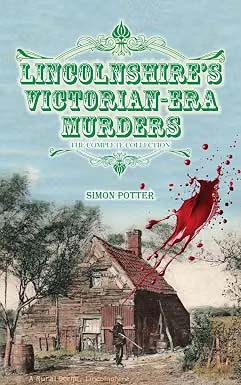
Lincolnshire's
Victorian-Era
Murders
|
'There was a dense mass from Ludgate Hill far up into Smithfield, and every window and housetop that commended a view of the scaffold were occupied,' reported the London Evening Standard. 'Amongst the crowd were a large number of well-dressed females – many young women attired in superior clothing, with hats and feather. The crush to obtain a sight of the proceedings was very severe, and but for the precautions taken to erect barriers across the roadway, some serious catastrophe, would, in all probability, have occurred.'
She had become the last woman to be hanged in public in London.
The liberal elite did not like the fact that the popularist majority enjoyed these spectacles so much, so decided that from 1868, executions would be held in private, within prison walls instead.
The bloodthirsty English public had to look elsewhere for their entertainment.
Newspapers carried on their sensation reporting and even upped it a notch. Penny dreadfuls continued selling hundreds of thousands of copies until moral panic set in during the late 1870s, amidst claims linking them to spiralling levels of juvenile crime.
And there was a big revival of the gothic horror genre, which had peaked in the 1790s. Robert Louis Stevenson's Strange Case of Dr. Jekyll and Mr. Hyde (1886), Oscar Wilde's Picture of Dorian Gray (1891), and Bram Stoker's Dracula (1897) were all phenomenally successful.
Stories of murder – be they fact or fiction – are a giant unstoppable snowball, getting bigger and bigger as each year goes by. And it was the Victorians who started it off.
Find Out More:
Simon Potter
https://www.victorianmurders.co.uk
Lincolnshire's Victorian-Era Murders
Spring-heeled Jack
https://en.wikipedia.org/wiki/Spring-heeled_Jack
|

 Discover thousands of Victorian images in our